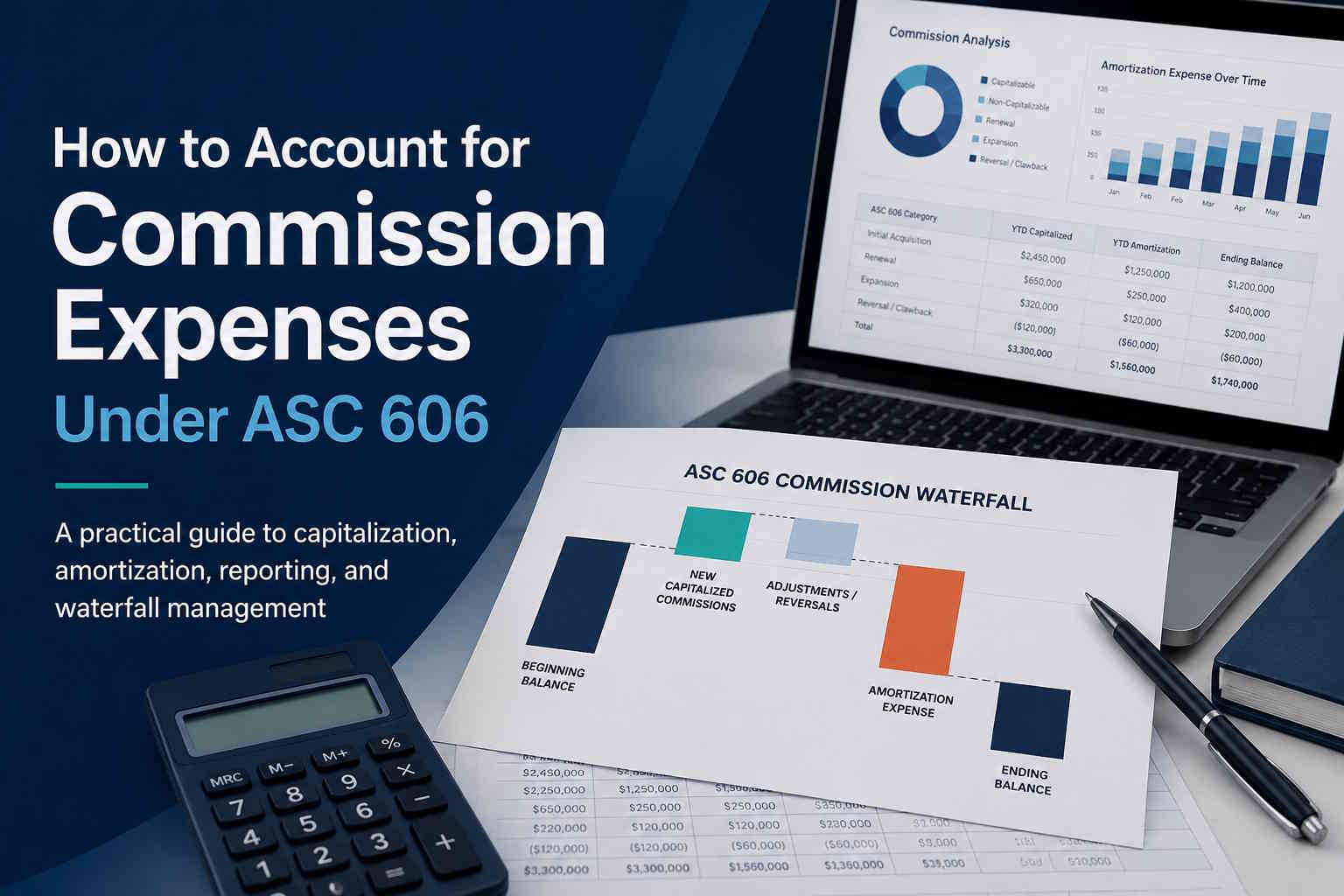
ASC 606 changed the way companies account for sales commissions and other contract acquisition costs. Instead of immediately expensing commissions when they are paid, many organizations are now required to capitalize and amortize those costs over time.
For SaaS and recurring revenue businesses, this creates new operational and reporting challenges:
- Tracking commission expenses by accounting treatment
- Managing ASC 606 waterfalls
- Supporting audits with transaction-level detail
- Reconciling compensation systems with ERP platforms
- Handling renewals, clawbacks, and expansions consistently
Without the right systems in place, finance teams often end up relying on spreadsheets and manual reconciliation processes that become difficult to scale.
EasyComp helps simplify ASC 606 commission accounting by allowing organizations to classify transactions by ASC 606 category, automate reporting workflows, and either manage the waterfall directly inside EasyComp or export data into financial systems such as NetSuite, Sage Intacct, Oracle, or SAP.
What Is ASC 606?
ASC 606 is the accounting standard governing revenue recognition and certain contract acquisition costs. One important requirement under ASC 606 is that companies must capitalize “incremental costs of obtaining a contract” if those costs are expected to be recovered.
In many cases, this includes sales commissions.
Example
If a sales representative earns a $15,000 commission for closing a 3-year SaaS agreement, the company may need to:
- Capitalize the commission as a contract acquisition asset
- Amortize the expense over the expected customer benefit period
- Maintain an ASC 606 commission waterfall to track balances over time
This process ensures that commission expenses are recognized in alignment with the revenue generated from the customer relationship.
Common ASC 606 Commission Categories
Finance teams often need to distinguish between multiple commission expense types, including:
- Initial acquisition commissions
- Renewal commissions
- Expansion commissions
- Residual commissions
- SPIFFs and bonuses
- Draws and recoverable advances
- Clawbacks and reversals
Different categories may require different accounting treatment depending on company policy.
This is one reason why transaction-level classification is critical for ASC 606 compliance.
Challenges of ASC 606 Commission Accounting
Many organizations still manage ASC 606 reporting manually using spreadsheets and disconnected systems.
Common challenges include:
Manual Waterfalls
Finance teams often maintain offline amortization schedules that are difficult to update and reconcile.
Inconsistent Classification
Without standardized tagging, commission transactions may be categorized differently across teams and reporting periods.
Audit Complexity
Auditors frequently request transaction-level support for capitalized commissions and amortization calculations.
Month-End Reconciliation Work
Compensation data often must be manually exported, transformed, and loaded into financial systems.
As compensation plans become more sophisticated, these processes become increasingly difficult to scale.
How EasyComp Simplifies ASC 606 Reporting
EasyComp was designed to support complex compensation plans while making downstream financial reporting easier and more reliable.
ASC 606 Transaction Tagging
EasyComp allows organizations to classify commission transactions by ASC 606 category directly within the compensation workflow.
Examples include:
- Capitalizable acquisition costs
- Non-capitalizable incentive payments
- Renewal-related commissions
- Expansion-related commissions
- Reversal and clawback transactions
- Amortizable contract acquisition assets
Because the accounting classification is embedded directly into the transaction data, finance teams can generate accurate reports without relying on manual spreadsheet mapping.
Related: Automating Sales Commissions: Benefits, Challenges, and What Most Companies Get Wrong
ASC 606 Waterfall Reporting in EasyComp
EasyComp supports multiple approaches to ASC 606 waterfall management.
Option 1: Run the Waterfall Inside EasyComp
Some organizations choose to manage the operational waterfall directly within EasyComp.
The platform can support:
- Beginning balances
- New capitalized commission additions
- Monthly amortization expense
- Adjustments and reversals
- Ending balances by reporting period
This creates a centralized operational source of truth tied directly to the original commission calculations.
Because every waterfall entry is connected to underlying transaction data, audit support and reconciliation become significantly easier.
Related: Why Real-Time Commission Calculations Are No Longer Optional
Option 2: Export ASC 606 Expenses to Your Financial System
Other organizations prefer to maintain the official waterfall in their ERP or accounting platform.
EasyComp makes this easy by allowing teams to export:
- Capitalized commission expenses
- Transaction-level detail
- ASC 606 category mappings
- Period-based amortization schedules
- Waterfall-ready reporting datasets
These exports can feed downstream accounting workflows in:
- NetSuite
- Sage Intacct
- Oracle
- SAP
- Microsoft Dynamics
- Custom financial models
Benefits of Using EasyComp for ASC 606 Commission Accounting
Reduce Manual Reconciliation
Automated tagging and reporting eliminate many spreadsheet-driven workflows.
Improve Audit Readiness
Transaction-level traceability makes supporting audits much easier.
Accelerate Month-End Close
Finance teams can quickly generate ASC 606-ready reports directly from compensation data.
Improve Reporting Accuracy
Embedded classification logic reduces inconsistencies and human error.
Scale With Complex Compensation Plans
As compensation plans evolve, reporting workflows remain manageable and standardized.
Best Practices for ASC 606 Commission Accounting
Organizations implementing ASC 606 commission accounting should consider the following best practices:
Standardize Commission Categories
Define clear accounting classifications for every commission type.
Maintain Transaction-Level Detail
Auditors often require granular support for capitalization and amortization entries.
Align Compensation and Finance Systems
Disconnected systems create reconciliation risk and operational inefficiency.
Automate Waterfall Reporting
Manual waterfall schedules become difficult to maintain as organizations scale.
Build Repeatable Reporting Processes
Standardized reporting workflows improve consistency and reduce close timelines.
Conclusion
ASC 606 significantly increased the complexity of commission accounting for many organizations. What was once a straightforward expense process now requires capitalization, amortization, waterfall tracking, and detailed audit support.
EasyComp helps simplify this process by enabling organizations to:
- Tag commission transactions by ASC 606 category
- Automate reporting workflows
- Manage waterfalls directly inside EasyComp
- Export waterfall-ready data into ERP systems
- Maintain transaction-level traceability for audits
For SaaS, subscription, and recurring revenue businesses, integrating compensation operations with financial reporting can dramatically reduce manual effort while improving visibility and compliance.
To learn more, Book a Call.
Frequently Asked Questions
What commissions must be capitalized under ASC 606?
Generally, incremental costs of obtaining a contract that are expected to be recovered must be capitalized. This often includes sales commissions directly tied to acquiring customer contracts.
What is an ASC 606 commission waterfall?
An ASC 606 commission waterfall tracks beginning balances, newly capitalized commissions, amortization expense, adjustments or reversals, and ending balances. It helps organizations manage contract acquisition assets over time.
Can commission waterfalls be managed outside the ERP?
Yes. Many companies manage operational waterfalls in compensation systems like EasyComp while maintaining official accounting records in their ERP.
Does EasyComp support ASC 606 reporting?
Yes. EasyComp allows organizations to tag transactions by ASC 606 category, generate waterfall-ready reporting, export commission expense data, support transaction-level audit traceability, and manage operational waterfalls directly within the platform.
Which financial systems can EasyComp integrate with?
EasyComp supports exports and integrations for systems including NetSuite, Sage Intacct, SAP, Oracle, Microsoft Dynamics, and custom accounting workflows.
Why is transaction-level tagging important for ASC 606?
Transaction-level tagging ensures that commission expenses are consistently categorized and reportable, reducing reconciliation work and improving audit readiness.