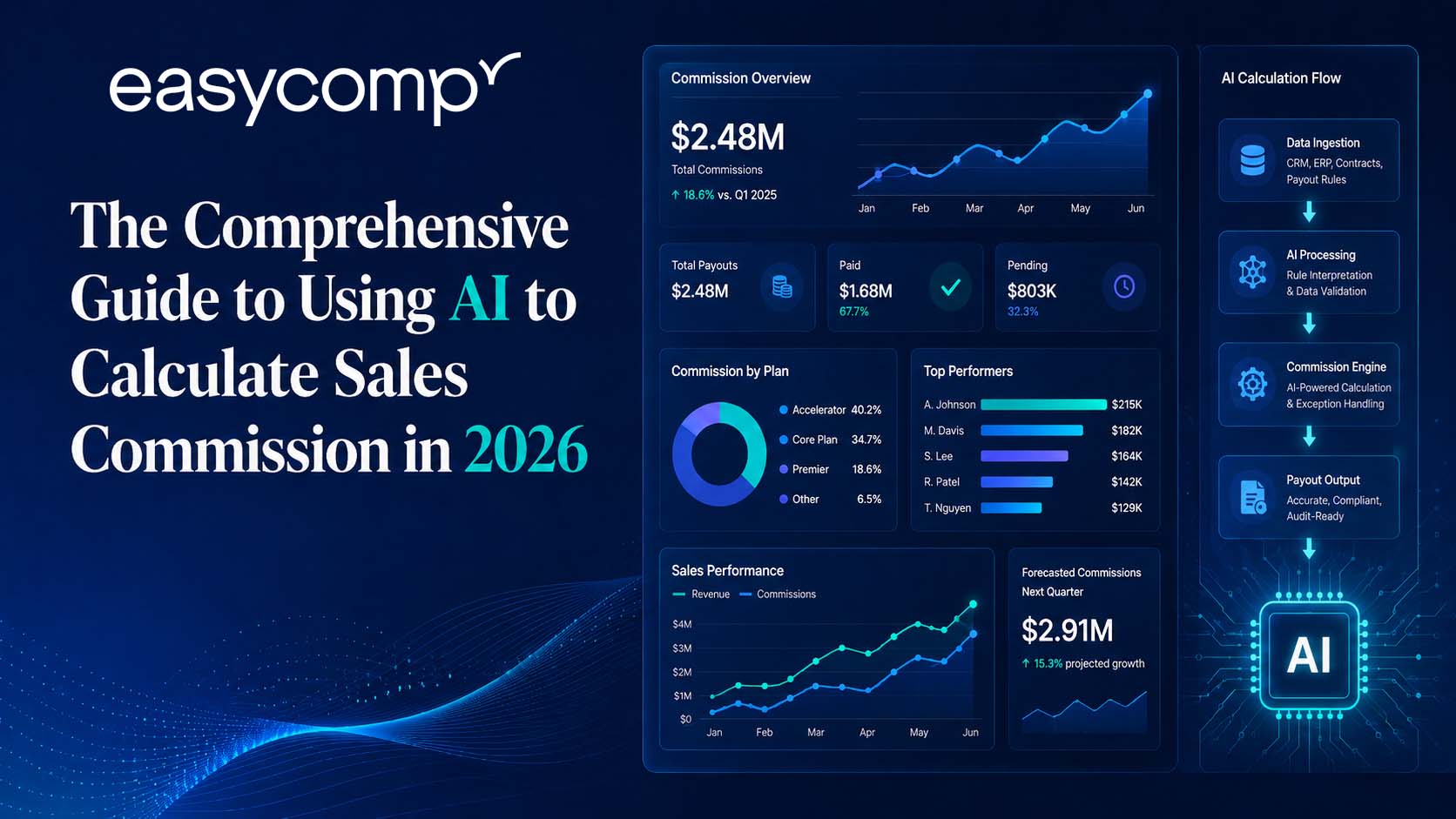
Sales commission calculation is one of the most important workflows in revenue operations. It affects sales rep motivation, finance accuracy, payroll, quota attainment, and trust between the company and its go-to-market team.
In 2026, artificial intelligence is changing how companies manage commissions. AI can help teams clean data, interpret compensation plans, detect payout errors, forecast commission expense, answer rep questions, and explain calculations in plain English.
But AI should not turn sales commissions into a black box.
The best approach to AI sales commission calculation is to combine reliable rules-based commission logic with AI-assisted workflows for validation, explanation, forecasting, and support. This guide explains how to use AI to calculate sales commissions in 2026, where AI adds the most value, what risks to avoid, and how EasyComp helps teams make commission management clearer and more scalable.
Table of Contents
- What Is AI Sales Commission Calculation?
- Why Sales Commission Calculation Is So Complex
- Benefits of Using AI to Calculate Sales Commissions
- 7 Best AI Use Cases for Sales Commission Calculation
- What AI Should Not Do in Commission Calculation
- Deterministic Rules vs. AI in Sales Commission Software
- AI-Powered Commission Calculation Workflow
- How AI Improves Commission Transparency
- Governance and Compliance Considerations
- Common Mistakes to Avoid
- What to Look for in AI Commission Software
- How EasyComp Approaches AI Commission Management
- Implementation Roadmap for 2026
- FAQ: AI Sales Commission Calculation
What Is AI Sales Commission Calculation?
AI sales commission calculation is the use of artificial intelligence to assist with the workflows involved in calculating, validating, explaining, forecasting, and managing sales commission payouts.
It does not mean asking a chatbot to decide how much every sales rep should be paid.
A better definition is:
AI sales commission calculation uses artificial intelligence to improve the data preparation, validation, forecasting, explanation, and support workflows around commissions, while preserving approved compensation rules and human oversight for final payout decisions.
A modern AI-assisted commission process may include:
- Pulling data from CRM, billing, ERP, payroll, and data warehouse systems.
- Normalizing sales, customer, contract, and rep data.
- Applying approved commission rules.
- Detecting payout anomalies before payroll.
- Explaining commission statements in plain English.
- Forecasting expected commission expense.
- Helping sales operations teams resolve disputes faster.
- Analyzing whether compensation plans are driving the right behavior.
The goal is not to make commissions mysterious. The goal is to make commissions easier to calculate, easier to audit, and easier to understand.
Why Sales Commission Calculation Is So Complex
On the surface, sales commission calculation sounds simple: a sales rep closes a deal, the company applies a commission rate, and the rep gets paid.
In reality, commission plans often involve many rules and exceptions.
A commission calculation may need to answer questions like:
- Which sales rep receives credit for the deal?
- Is the transaction new business, expansion, renewal, upsell, cross-sell, services, or another deal type?
- Does the deal count toward quota attainment?
- Should credit be split across multiple reps, managers, or teams?
- Which date determines the commission period: close date, booking date, invoice date, payment date, revenue recognition date, or contract start date?
- Has the customer paid the invoice?
- Is the rep eligible for an accelerator?
- Does the deal include discounts, ramp periods, free months, cancellations, or amendments?
- Is there a clawback risk?
- Does a manual adjustment, draw, guarantee, cap, or SPIFF apply?
- Which version of the compensation plan was active when the deal was booked?
These questions require more than arithmetic. They require accurate data, clear rules, approval workflows, audit trails, and rep-facing explanations.
That is why spreadsheet-based commission calculation often becomes fragile as companies scale. Spreadsheets can calculate numbers, but they are not built for plan versioning, approval routing, exception handling, source data lineage, or dispute resolution.
This is where AI-powered commission software can help.
Benefits of Using AI to Calculate Sales Commissions
When implemented carefully, AI can improve commission management across sales, finance, and operations.
Key benefits include:
Faster commission cycles
AI can help identify data issues, classify transactions, summarize exceptions, and prepare commission review faster than manual spreadsheet workflows.
Fewer payout errors
AI can detect duplicate credits, unusual payout amounts, missing commissions, incorrect deal types, and unexpected rate changes before commissions are finalized.
Better sales rep experience
AI-generated explanations can help reps understand how each payout was calculated, which deals counted toward quota, and why certain deals were excluded.
Stronger finance controls
AI-assisted review workflows can help finance teams identify high-risk payouts, large adjustments, and commission expense anomalies before payroll.
More accurate forecasting
AI can help estimate commission expense based on pipeline, quota attainment, tier progression, accelerators, and expected deal timing.
Less manual work for sales operations
Instead of answering the same payout questions repeatedly, sales operations teams can use AI to generate grounded explanations and investigate disputes faster.
7 Best AI Use Cases for Sales Commission Calculation
1. Preparing commission-ready data
Commission errors often start with messy source data.
CRM fields may be incomplete. Deal types may be inconsistent. Account ownership may change. Billing data may arrive late. Payment status may not match the commission period. Product SKUs may be mapped incorrectly.
AI can help by:
- Detecting inconsistent deal classifications.
- Suggesting missing account, rep, or territory mappings.
- Flagging suspicious date combinations.
- Matching customer records across systems.
- Identifying duplicate transactions.
- Summarizing data quality issues before payroll review.
For example, AI might flag a deal labeled as new business even though the account had prior revenue in the last 12 months. Or it might identify that a rep’s territory changed mid-quarter and the deal needs manual review before credit is assigned.
Clean data is the foundation of accurate commission calculation.
2. Interpreting compensation plan documents
Sales compensation plans are often written in natural language, but commission systems need structured logic.
A plan might say:
Account Executives earn 8% commission on new logo ARR until 100% quota attainment, then 12% on incremental ARR above quota. Expansion deals are paid at 6%. Renewals are not commissionable unless net retention exceeds 110%.
AI can help translate plan language into structured requirements by identifying:
- Eligible roles.
- Commissionable events.
- Rate tables.
- Quota thresholds.
- Accelerator rules.
- Deal type definitions.
- Exclusions.
- Caps and floors.
- Timing rules.
- Required source fields.
However, AI-generated plan logic should always be reviewed, tested, approved, and version-controlled before it affects payouts.
AI can accelerate plan implementation, but it should not replace compensation governance.
3. Explaining commission payouts in plain English
Sales reps should not need to reverse-engineer a spreadsheet to understand their commission statement.
AI can generate clear explanations like:
You earned $4,200 on the Acme deal because it was classified as new business ARR, booked on March 12, credited 100% to you, and paid at your 10% base commission rate. The deal did not receive accelerator credit because your cumulative attainment before this deal was 82% of quota.
This type of explanation improves trust and reduces repetitive questions for sales operations and finance teams.
The explanation must be grounded in the actual data and commission rules. AI should explain the calculation, not invent a reason after the fact.
4. Detecting commission anomalies before payroll
AI can help identify unusual commission results before they become payroll problems.
Examples of commission anomalies include:
- A payout that is much higher than historical norms.
- A negative payout that may indicate a clawback or data issue.
- A rep receiving credit for a deal outside their territory.
- A closed-won opportunity with no commission payout.
- Multiple reps receiving 100% credit for the same deal.
- A renewal incorrectly classified as new business.
- A commission rate that does not match the rep’s assigned plan.
- A large payout caused by a duplicate transaction or missing cap.
Traditional validation rules are still important. AI adds value by identifying unusual patterns that may not have been explicitly hard-coded.
For example, if a rep’s effective commission rate suddenly jumps from 9% to 27%, AI can flag the transaction for review even if no single rule was violated.
5. Forecasting commission expense
Commission forecasting helps both reps and finance teams.
Sales reps want to know what they are on track to earn. Finance teams need to forecast commission expense and accruals. Sales leaders want to understand how compensation plans influence behavior.
AI can help forecast:
- Expected rep earnings.
- Commission expense by month or quarter.
- Accelerator exposure.
- Pipeline-driven payout scenarios.
- Quota attainment probabilities.
- Budget risk from large late-stage deals.
- The payout impact of renewals, expansions, and new logos.
This is especially useful when sales compensation plans include tiers, accelerators, quotas, ramp rules, or team-based incentives.
The best forecasting models do not only forecast revenue. They forecast compensation impact.
6. Supporting commission disputes
Commission disputes are time-consuming because they often require teams to trace data across multiple systems.
A rep might ask:
Why wasn’t I paid on this deal?
To answer, sales operations may need to check CRM opportunity data, account ownership, plan eligibility, deal type, close date, invoice status, payment status, quota credit, and manual adjustments.
AI can act as an investigation assistant by summarizing the likely reason and surfacing the relevant records.
A useful AI-assisted answer might say:
This deal was not paid in the March commission period because the plan pays commissions only after first invoice payment. The opportunity closed on March 18, but the first payment was received on April 4, so the payout is expected in the April cycle.
That answer is valuable because it is specific, traceable, and tied to the actual compensation plan.
7. Improving compensation plan design
AI can also help revenue leaders evaluate whether sales compensation plans are working as intended.
AI can analyze:
- Which reps are consistently near accelerator thresholds.
- Whether top performers are being rewarded appropriately.
- Whether territories are balanced.
- Whether SPIFFs are changing seller behavior.
- Whether payout curves are too flat or too volatile.
- Whether commission cost aligns with gross margin.
- Whether reps are being overpaid for low-retention or delayed-payment deals.
This moves AI beyond calculation and into compensation strategy.
The goal is not only to pay commissions accurately. The goal is to design incentives that drive the right revenue behavior.
What AI Should Not Do in Commission Calculation
AI is useful, but commission calculation is not the right place for uncontrolled automation.
Companies should avoid using AI to:
- Invent commission rules without approval.
- Override approved compensation plans without review.
- Make unexplained payout changes.
- Hide calculation logic inside a black-box model.
- Use inappropriate employee attributes in payout decisions.
- Replace audit trails with narrative summaries.
- Push unreviewed calculations directly to payroll.
- Answer rep questions without grounding responses in real data.
Commission payouts affect income. If reps believe the system is unpredictable, trust erodes quickly. If finance cannot audit the numbers, close processes slow down. If operations teams cannot explain how a payout was produced, every exception becomes a dispute.
AI should make commission calculation more transparent, not less.
Deterministic Rules vs. AI in Sales Commission Software
The best sales commission software uses both deterministic rules and AI assistance.
Deterministic rules are best for:
- Calculating final payout amounts.
- Applying approved commission rates.
- Enforcing tiers, caps, accelerators, and eligibility rules.
- Applying plan effective dates.
- Calculating quota attainment.
- Managing splits and crediting rules.
- Producing payroll-ready outputs.
- Preserving auditability.
AI is best for:
- Finding data quality issues.
- Interpreting plan documents.
- Suggesting mappings and classifications.
- Detecting anomalies.
- Explaining calculations.
- Forecasting outcomes.
- Answering commission questions.
- Summarizing disputes.
- Recommending process improvements.
A simple rule of thumb:
Rules should calculate. AI should assist, explain, and improve.
That separation matters because sales commission payouts need to be reliable, repeatable, and auditable.
AI-Powered Commission Calculation Workflow
A practical AI-powered commission workflow in 2026 includes seven steps.
Step 1: Connect commission source systems
Start by connecting the systems that contain commission-relevant data, such as:
- CRM.
- Billing system.
- ERP.
- Payment processor.
- Payroll system.
- HRIS.
- Data warehouse.
- Contract management system.
- Spreadsheet-based exception files.
The goal is to create a reliable commission data layer.
Step 2: Normalize and validate data
Before calculating commissions, validate fields such as:
- Rep assignments.
- Account ownership.
- Deal types.
- Product mappings.
- Currency conversions.
- Date fields.
- Contract terms.
- Payment status.
- Revenue recognition inputs.
- Duplicate or missing records.
AI can flag issues and suggest fixes, but teams should define which fixes can be automated and which require approval.
Step 3: Apply approved compensation logic
Commission payouts should be calculated using approved, version-controlled rules.
This includes:
- Plan eligibility.
- Quota attainment.
- Commission rates.
- Tiers and accelerators.
- Splits.
- Clawbacks.
- Guarantees.
- Draws.
- Caps.
- SPIFFs.
- Manual adjustments.
This is where deterministic calculation matters most.
Step 4: Run AI-assisted review
After preliminary calculations are complete, AI can help review results by flagging:
- Outlier payouts.
- Missing commissions.
- Unexpected payout changes.
- Unusual effective rates.
- Duplicate credits.
- Policy exceptions.
- Large manual adjustments.
- Deals requiring manager approval.
This creates a smarter review queue for sales operations and finance.
Step 5: Generate payout explanations
For every payout, the system should show:
- The source transaction.
- The credited rep.
- The applicable plan.
- The commissionable amount.
- The rate or tier applied.
- The quota impact.
- Any adjustments.
- The final payout.
- A plain-English explanation.
This is where AI can materially improve the rep experience.
Step 6: Route approvals
Commission workflows should include approvals for:
- Large payouts.
- Manual adjustments.
- Exceptions.
- Disputes.
- Clawbacks.
- Plan overrides.
- Payroll exports.
AI can summarize what needs attention, but approval ownership should remain clear.
Step 7: Publish commission statements
Once approved, reps and managers should be able to view commission statements with deal-level detail and clear explanations.
Reps should be able to answer questions like:
- Why did my payout change from last month?
- Which deals counted toward my quota?
- Why did this deal not qualify for an accelerator?
- What would I earn if this pipeline deal closes?
- Which payout is pending customer payment?
The best commission experience is not just a number. It is a number with context.
How AI Improves Commission Transparency
Trust is the hidden metric in commission operations.
A commission system is not successful just because it produces a payout file. It is successful when reps, managers, sales operations, finance, and leadership trust the numbers.
AI can improve trust when it helps teams answer four questions:
- Where did this number come from?
- Which commission rule was applied?
- Which data was used?
- Who approved the final payout?
If AI makes those answers easier to find, it improves commission transparency.
If AI makes those answers harder to find, it creates risk.
That is why explainability is central to AI commission management.
Governance and Compliance Considerations
Because commissions affect employee compensation, companies should treat AI-assisted commission workflows carefully.
Important governance practices include:
- Maintaining an audit trail for every payout.
- Keeping approved compensation plan rules version-controlled.
- Separating draft calculations from approved payroll outputs.
- Logging manual adjustments and approvals.
- Restricting who can change plan logic.
- Testing AI-generated recommendations before use.
- Monitoring for inconsistent treatment or inappropriate data use.
- Giving reps access to understandable payout explanations.
- Ensuring AI-generated answers are grounded in actual data.
Companies operating across multiple jurisdictions should also consider employment, payroll, privacy, and AI governance requirements. Any AI system that influences pay, performance, or work-related terms should be implemented with extra care.
The practical takeaway: AI commission calculation should be treated as a governed financial and employee-facing workflow, not an experimental side project.
Common Mistakes to Avoid
Mistake 1: Starting with AI before fixing the data
AI cannot reliably calculate commissions from broken data. If CRM, billing, payroll, and rep assignment data are inconsistent, AI may only surface inconsistencies faster.
Fix the data foundation first.
Mistake 2: Letting AI become the source of truth
AI should not be the source of truth for commission policy. Approved compensation plans, source systems, and controlled calculation logic should remain authoritative.
Mistake 3: Creating explanations without traceability
A polished explanation is not enough. Every explanation should connect back to the transaction, plan, rule, and data fields used in the calculation.
Mistake 4: Automating exceptions too aggressively
Exceptions are often where the biggest payout risks live. Use AI to identify and summarize exceptions, but keep approval workflows in place.
Mistake 5: Ignoring the sales rep experience
AI should not only help finance and operations teams. It should also help reps understand how they are paid, what they can influence, and what to expect.
What to Look for in AI Commission Software
When evaluating AI commission software, look for tools that improve both automation and control.
Important features include:
- CRM, billing, ERP, payroll, and data warehouse integrations.
- Flexible sales compensation plan modeling.
- Version-controlled commission rules.
- Deal-level calculation traceability.
- AI-assisted data validation.
- Commission anomaly detection.
- Plain-English payout explanations.
- Rep-facing commission statements.
- Forecasting and accrual support.
- Commission dispute management.
- Approval workflows.
- Audit logs.
- Role-based permissions.
- Scenario modeling.
- Manual adjustment controls.
- Payroll export support.
The most important question is not, “Does this platform have AI?”
The better question is:
Does this platform make commission calculation more accurate, explainable, and trustworthy?
How EasyComp Approaches AI Commission Management
EasyComp is built around a simple belief: commission management should be clear.
Sales reps should understand how their earnings are calculated. Finance teams should be able to audit payouts. Sales operations teams should be able to manage complex plans without living in fragile spreadsheets. Leadership should be able to see how compensation connects to performance.
AI fits into that vision when it helps teams:
- Clean and validate commission data.
- Identify calculation issues before payroll.
- Explain payouts in plain English.
- Reduce repetitive operational work.
- Support faster dispute resolution.
- Forecast commission expense.
- Improve plan design over time.
EasyComp does not believe commission calculation should become a black box.
The future of AI in sales commissions is not “trust the model.” It is “trust the process, see the data, understand the calculation, and use AI to make the workflow better.”
Implementation Roadmap for 2026
If your company is considering AI-assisted commission calculation in 2026, use this practical roadmap.
Phase 1: Document the current commission process
Map your existing workflow:
- Source systems.
- Plan documents.
- Spreadsheet logic.
- Manual adjustments.
- Approval steps.
- Payroll handoff.
- Dispute process.
- Reporting needs.
This creates the baseline for automation.
Phase 2: Clean and standardize commission data
Identify the fields that drive commission calculations:
- Rep ID.
- Account ID.
- Opportunity ID.
- Deal type.
- Booking amount.
- ARR.
- Contract dates.
- Close date.
- Payment date.
- Product type.
- Territory.
- Quota.
- Plan assignment.
Then define ownership and validation rules for each field.
Phase 3: Encode approved compensation rules
Translate compensation plans into structured logic. Test the rules against historical payouts and known edge cases.
Make sure teams can answer:
- Which plan version applies?
- Which transactions are eligible?
- Which rates apply?
- How are accelerators calculated?
- How are splits handled?
- What happens when data is missing?
Phase 4: Add AI review and explanations
Once the baseline calculation is reliable, add AI-assisted capabilities:
- Data issue detection.
- Outlier review.
- Explanation generation.
- Dispute summaries.
- Forecasting.
- Scenario analysis.
AI should enhance a reliable process, not compensate for a broken one.
Phase 5: Monitor and improve
After launch, track metrics such as:
- Payout accuracy.
- Dispute volume.
- Time to close commissions.
- Manual adjustment frequency.
- Rep question volume.
- Payroll rework.
- Commission expense variance.
- Plan effectiveness.
Use these metrics to continuously improve the commission process.
FAQ: AI Sales Commission Calculation
Can AI calculate sales commissions?
Yes, AI can assist with sales commission calculation by preparing data, detecting errors, explaining payouts, forecasting commission expense, and supporting disputes. However, final payout amounts should usually be calculated using approved, deterministic compensation rules so the results are reliable and auditable.
Is AI better than spreadsheets for commissions?
AI-assisted commission software can be much more scalable than spreadsheets when companies need data validation, version control, approval workflows, audit trails, forecasting, and rep-facing explanations. Spreadsheets may work for simple plans, but they often become fragile as sales teams, plans, and exceptions grow.
What is the biggest risk of using AI for commission calculation?
The biggest risk is turning compensation into a black box. Commission payouts affect people’s income, so teams need clear rules, auditability, approval workflows, and explanations. AI should make commission calculations easier to understand, not harder.
How does AI help sales reps understand commissions?
AI can generate plain-English explanations that show how each commission payout was calculated. These explanations can include the deal, credited rep, commissionable amount, plan rule, rate, quota impact, adjustments, and final payout.
Should AI decide commission payouts automatically?
In most cases, no. AI should assist with data preparation, anomaly detection, forecasting, and explanations, while approved compensation rules and human review should govern final payouts.
What data is needed for AI commission calculation?
Common data sources include CRM opportunities, accounts, rep assignments, compensation plans, quotas, billing data, payment status, contract terms, payroll data, and manual adjustments.
How can companies start using AI for commission management?
Start by documenting the current commission process, cleaning source data, encoding approved compensation rules, and testing historical calculations. After the baseline workflow is reliable, add AI for validation, explanations, forecasting, and dispute support.
Conclusion: AI Should Make Commissions Easier to Trust
AI can transform sales commission calculation, but only when used thoughtfully.
The best AI-powered commission systems do not replace compensation expertise. They amplify it. They help teams clean data, apply rules, catch mistakes, explain payouts, support reps, and improve plans over time.
For companies still managing commissions in spreadsheets, 2026 is a good time to rethink the process. The goal is not simply to calculate commissions faster. The goal is to build a commission workflow that is accurate, transparent, scalable, and trusted by everyone involved.
EasyComp helps companies move from manual, confusing, spreadsheet-heavy commission processes to clear, explainable, AI-assisted commission management.
Ready to modernize your commission process? Schedule a demo with EasyComp to see how your team can calculate commissions clearly, reduce payout disputes, and give reps better visibility into their earnings.