Sales compensation is one of the biggest drivers of motivation, performance, and retention for revenue teams. But for many reps, commissions still feel like a black box. They wait weeks to understand what they earned, manually reconcile spreadsheets, or constantly message finance and RevOps with questions like:
- “Why did this deal pay out less than expected?”
- “Did my accelerator kick in yet?”
- “When will this commission hit payroll?”
- “Which opportunities are actually counting toward quota?”
A great sales commission dashboard eliminates this uncertainty. It gives reps confidence in their earnings, clarity into performance, and visibility into what actions will maximize future payouts.
At EasyComp, we believe commission software should not just calculate commissions accurately — it should help reps understand them instantly.
If you’re evaluating a modern sales commission software platform, here’s what every great dashboard should include.
1. Real-Time Commission Visibility
The first thing every rep wants to know is simple:
How much have I earned so far?
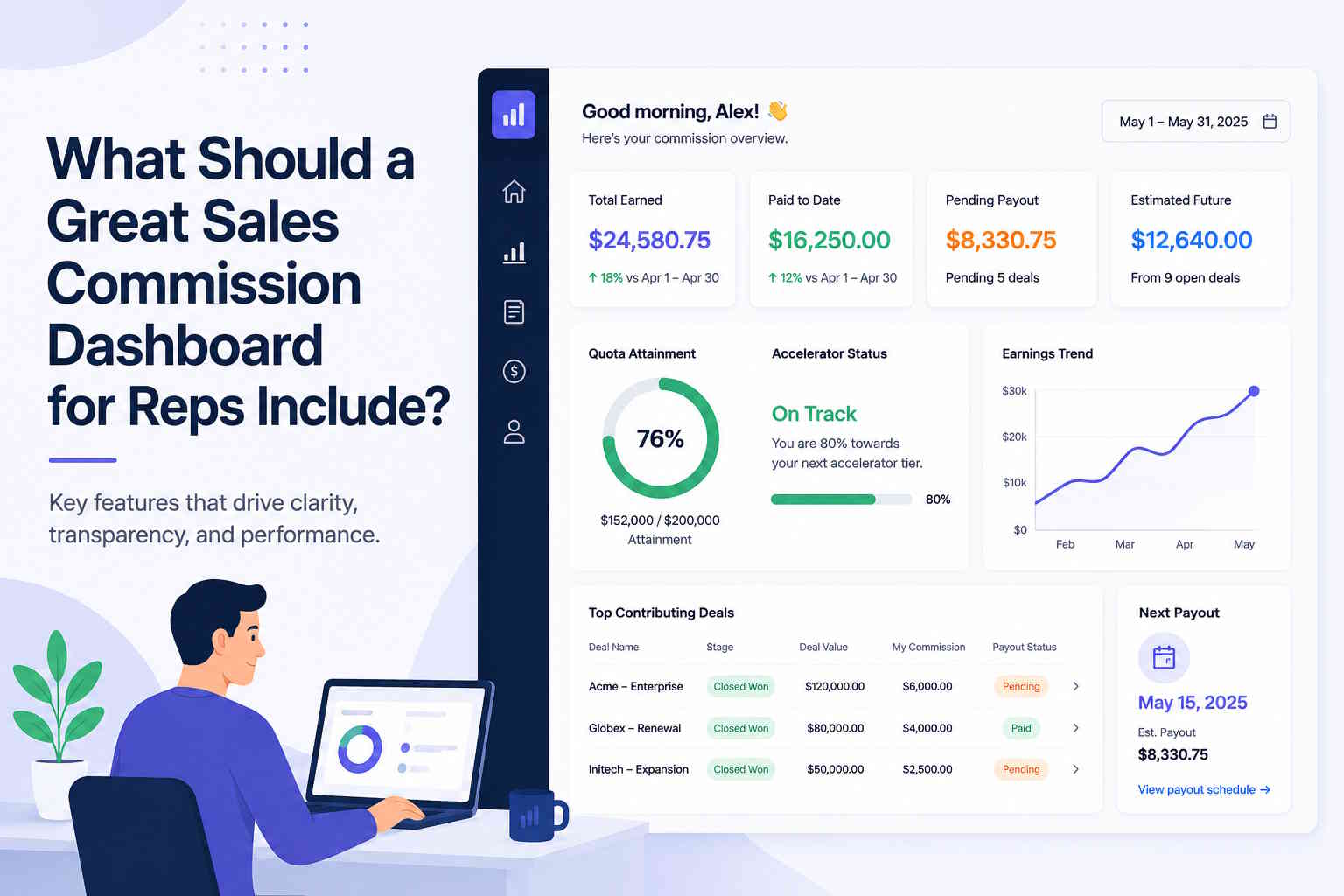
A great sales commission dashboard should provide: - Current earned commissions - Paid commissions - Pending payouts - Estimated future earnings - Quota attainment progress - Accelerator status
Most companies still rely on monthly spreadsheets or delayed commission statements. That lag creates uncertainty and unnecessary questions for RevOps and finance teams.
With EasyComp, reps can see their earnings update dynamically as deals move through the compensation lifecycle — from booking to collections to payout.
Why it matters
Real-time visibility increases trust, improves motivation, and reduces end-of-month commission disputes.
Related: Why Spreadsheets Break at Scale for Sales Compensation
2. Transparent Commission Calculations
One of the biggest frustrations in sales compensation is not the payout amount itself — it’s not understanding how the number was calculated.
A strong dashboard should answer: - Which deals contributed to this payout? - What commission rate was applied? - Were accelerators triggered? - Were there splits or overlays? - Were clawbacks applied? - Which compensation plan rules affected the calculation?
Transparency matters.
EasyComp focuses heavily on explainability. Instead of showing only final numbers, EasyComp breaks commissions down step-by-step using supporting deal data, plan logic, and payout rules.
Why it matters
Transparent compensation systems reduce disputes and improve rep confidence in commission payouts.
Related: How to Reduce Sales Commission Disputes
3. Deal-Level Drilldowns
High-level summaries are useful, but reps also need detailed visibility into individual opportunities.
A great dashboard should allow reps to: - Click into individual deals - View commission calculations at the opportunity level - See ARR, ACV, booking dates, and payout timing - Understand why a deal is pending or excluded - Track partial payouts and installments
This becomes especially important for complex compensation structures involving: - Multi-year contracts - Revenue recognition schedules - Collections-based commissions - Territory overlays - Split crediting - Usage-based pricing
EasyComp provides detailed deal-level drilldowns tied directly to compensation logic so reps can self-serve answers without relying on RevOps.
4. Commission Forecasting and “What-If” Modeling
Top-performing reps constantly ask:
“What happens if I close this deal?”
Modern compensation dashboards should help reps forecast: - Expected commissions from open pipeline - Accelerator thresholds - Quota pacing - End-of-quarter earnings projections - Potential payout scenarios
This transforms compensation software from a backward-looking reporting system into a proactive performance tool.
EasyComp helps organizations surface projected commissions and quota impact so reps can prioritize the opportunities that matter most.
Why it matters
Forecasting helps reps make smarter pipeline decisions and stay engaged throughout the quarter.
Related: Why Real-Time Commission Calculations Are No Longer Optional
5. Payout Timeline Visibility
One of the most common rep frustrations is uncertainty around when commissions will actually be paid.
A great dashboard should clearly show: - Earned vs payable commissions - Payroll processing status - Payment dependencies - Expected payout dates - Customer payment milestones
This is especially important for organizations that pay commissions after: - Customer collections - Revenue recognition - Implementation milestones - Multi-stage contract fulfillment
EasyComp gives reps visibility into the full payout lifecycle so they know not just what they earned, but when they can expect payment.
6. Mobile-Friendly and Easy to Use
Sales reps spend their day in CRMs, email, Slack, and mobile apps. Commission dashboards should be: - Fast - Intuitive - Mobile-friendly - Easy to navigate - Accessible without extensive training
If reps need RevOps assistance just to interpret their compensation dashboard, adoption will suffer.
EasyComp is designed to help reps quickly answer key compensation questions without digging through spreadsheets or disconnected systems.
7. Historical Performance Tracking
Reps and managers both benefit from understanding compensation trends over time.
A strong dashboard should include: - Historical earnings - Quota attainment trends - Accelerator performance history - Year-over-year comparisons - Historical payout statements
EasyComp centralizes historical compensation data so revenue teams can analyze long-term performance in one place.
Why it matters
Historical insights improve coaching, compensation planning, and rep performance management.
8. Reduced Commission Disputes
At many organizations, commission disputes create unnecessary friction between sales, finance, payroll, and RevOps.
The root problem is usually not inaccurate calculations — it’s lack of visibility.
A great dashboard reduces disputes by providing: - Full auditability - Transparent calculations - Consistent data sources - Self-service reporting - Clear compensation logic
EasyComp was built specifically to improve trust in compensation processes by making commission calculations understandable and accessible to reps.
The Future of Sales Commission Dashboards
Modern sales organizations expect the same level of transparency from compensation systems that they get from CRM and analytics platforms.
The best sales commission dashboards are no longer static payout reports. They are: - Real-time - Explainable - Predictive - Self-service - Integrated with operational systems
At EasyComp, we help organizations build commission experiences that reps actually trust and use — giving revenue teams clearer visibility into earnings, payouts, and performance.
Because when compensation is transparent, sales teams perform better.
Frequently Asked Questions
What is a sales commission dashboard?
A sales commission dashboard is a tool that allows sales reps and managers to track commissions, payouts, quota attainment, and compensation performance in real time.
Why is commission transparency important?
Transparent commission calculations reduce disputes, improve rep trust, and help sales teams understand exactly how payouts are calculated.
What features should commission software include?
Modern commission software should include: - Real-time earnings tracking - Transparent calculations - Deal-level drilldowns - Forecasting tools - Payout timelines - Historical reporting - Self-service visibility
How does EasyComp help sales teams?
EasyComp helps organizations automate commission calculations while giving reps detailed visibility into earnings, payouts, quota progress, and compensation logic.
How can commission dashboards reduce RevOps workload?
Self-service commission visibility significantly reduces manual questions, payout disputes, and spreadsheet reconciliation work for RevOps and finance teams.