Best Practices
Jan 20 2026

Sales compensation is one of the most powerful levers a SaaS company can pull.It influences seller behavior, shapes your go-to-market motion, impacts retention, and ultimately determines whether you scale revenue efficiently or create operational drag that compounds every quarter.
The challenge is that SaaS sales incentives are not one-size-fits-all.
The comp plan that works for a high-velocity inbound business will break the moment you introduce enterprise expansions, renewals, channel influence, or consumption-based pricing. And even when the plan design is solid, many teams struggle with the operational reality of executing compensation accurately, on time, and in a way that builds trust with the field.
In this post, we’ll break down the main GTM-specific considerations for SaaS sales incentives, plus how EasyComp helps Revenue Operations teams run compensation as a scalable system instead of a monthly fire drill.
In traditional transactional businesses, comp is often straightforward:
SaaS introduces complexity because “the deal” can mean very different things depending on how the business monetizes:
That means the compensation system needs to answer a much harder question:
What outcome are we paying for, and when does it count?
Many SaaS companies pay on ACV because it is simple, familiar, and aligns tightly to sales execution.
Pros
Risks
Net New ARR is a strong choice when you want the comp model to reflect durable growth.
Pros
Challenges
Consumption-based comp is increasingly common in modern SaaS, especially in data, infrastructure, and developer-first companies.
Pros
Challenges
Bottom line: the “best” metric depends on your GTM motion, product model, and how you want teams to behave quarter-to-quarter.
EasyComp helps SaaS companies support multiple crediting models so you can pay on ACV, Net New ARR, consumption, or blended approaches without having to rebuild everything in spreadsheets.
One of the biggest mistakes SaaS companies make is reusing a compensation plan across fundamentally different role structures.
This structure separates new business and post-sale ownership:
The key question is:
Who gets paid for what when responsibilities overlap?
Without crisp crediting rules:
In many enterprise SaaS orgs, account managers own both:
This is simpler operationally, but creates a natural risk:
new dollars get prioritized, renewals become an afterthought
If you want hybrid AMs to drive retention well, you need incentives that make renewals matter without making the plan overly complex.
EasyComp makes it easier to manage these models by supporting:
Modern SaaS selling is rarely a one-person sport.
Sales Engineers, Product Specialists, and Value Engineers often drive outcomes that directly impact revenue:
But these teams are frequently under-designed in comp planning. They get:
The most scalable systems tend to be:
EasyComp supports overlay models by letting you define:
This avoids the nightmare scenario where every deal turns into a manual, political discussion.
This is one of the most debated topics in SaaS GTM, and the right answer depends on your business.
The better question is:
What outcomes do CSMs truly control in your model?
Paying CSMs can work well when they influence:
Variable comp can backfire when renewals are controlled primarily by:
The best CSM comp structures avoid extremes.
Avoid
A SaaS-friendly approach
Most SaaS orgs use a combination:
EasyComp helps by calculating these metrics consistently and connecting them to payout logic in a way that is explainable to the team.
Even with great plan design, SaaS companies struggle to execute compensation because comp is not a one-time plan rollout.
It is a production operating system that needs to work every month.
The teams that scale comp successfully track and manage:
This is where many SaaS orgs hit the wall.
Spreadsheets break. Ad hoc adjustments pile up. The field loses trust. Finance gets nervous. RevOps becomes a monthly bottleneck.
EasyComp is built to help SaaS companies run sales compensation with the reality of modern GTM in mind.
Instead of forcing you into a rigid model, EasyComp helps you manage complexity without losing clarity.
EasyComp is designed for plans that pay on:
Whether you are compensating:
EasyComp supports multi-role incentives without forcing you into manual workarounds.
SaaS teams want to know one thing:
“How did you calculate my commission?”
EasyComp provides clear earnings explanations tied to the supporting data and plan logic so sellers trust the number and disputes drop.
EasyComp helps you run comp like a system:
When incentives are accurate, explainable, and delivered on time:
The best metric depends on your business model. Many SaaS companies pay on ACV for simplicity, Net New ARR for durable growth alignment, or consumption for usage-based monetization. The right answer is the metric that best drives your desired GTM behavior and aligns to unit economics.
Some do, especially when CSMs directly influence renewals and expansion outcomes. The best structures usually include a strong base and a variable component tied to GRR, NRR, or renewal performance within controllable scope.
Many SaaS companies use overlay incentive models for Sales Engineers tied to team performance, win rates, key deal milestones, or strategic product adoption. The goal is to align incentives without creating attribution conflict.
The most common failures are choosing the wrong metric, mismatch between comp and coverage model, unclear crediting rules, too many exceptions, and a lack of operational systems to calculate and explain earnings accurately.
SaaS compensation is complex because SaaS growth is complex.
You are balancing new revenue, renewals, expansion, product adoption, and sometimes consumption. You are aligning hunters and farmers. You are incorporating specialists and overlay roles. You are motivating CSMs while protecting retention economics. And you are doing all of this while trying to keep the machine operational, accurate, and scalable.
That is why the best RevOps teams treat compensation like a system.
EasyComp is built to be that system.
If you are scaling a SaaS GTM organization and want compensation that is accurate, explainable, and built for modern incentive models, EasyComp can help.
Want to see how EasyComp supports SaaS compensation plans end-to-end?
Reach out for a demo.
If you want, I can also:
By Jose Fernandez
About the Author
Jose Fernandez is part of the team behind EasyComp.ai, building infrastructure that helps companies run sales compensation without spreadsheets, confusion, or delays. He believes incentive systems should be easy to operate—and crystal clear to the people who earn them.

Gabe Salzer
Revenue Operations
Strategy - HIGHTOUCH

EasyComp is so intuitive that our sales team needed almost no training to get started. Now, our account executives have real-time payout visibility, with clear explanations that eliminate back-and-forth with operations, allowing them to stay focused on closing deals.
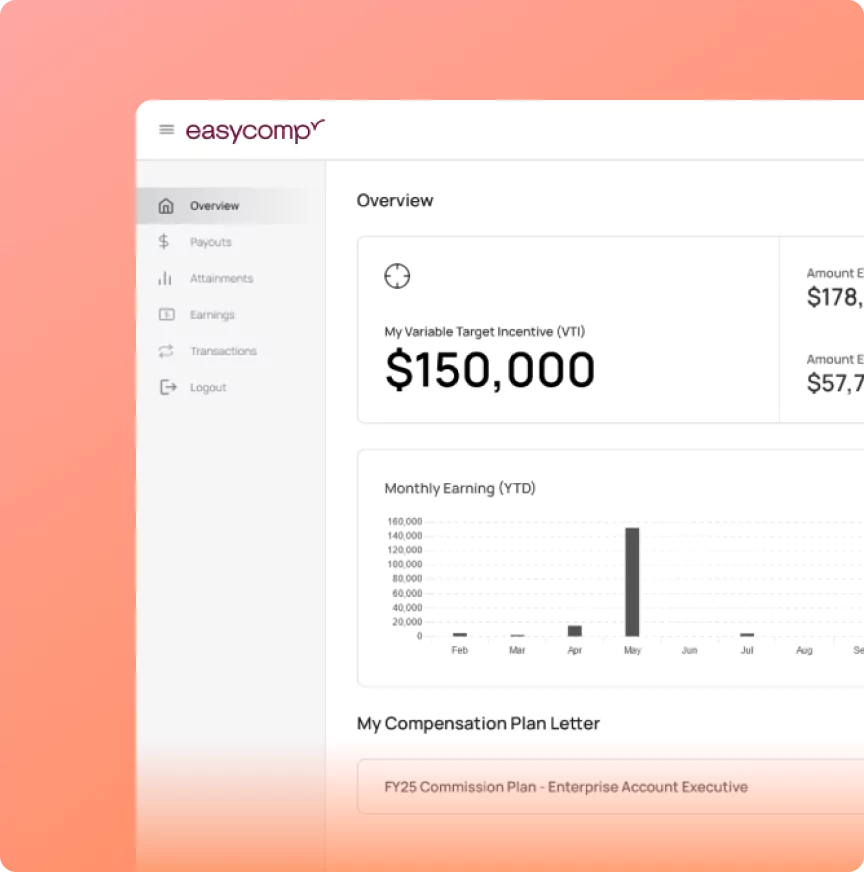

EasyComp's complete sales performance management platform streamlines compensation management for maximized revenue impact.

© 2024 EasyComp, Inc. All rights reserved.