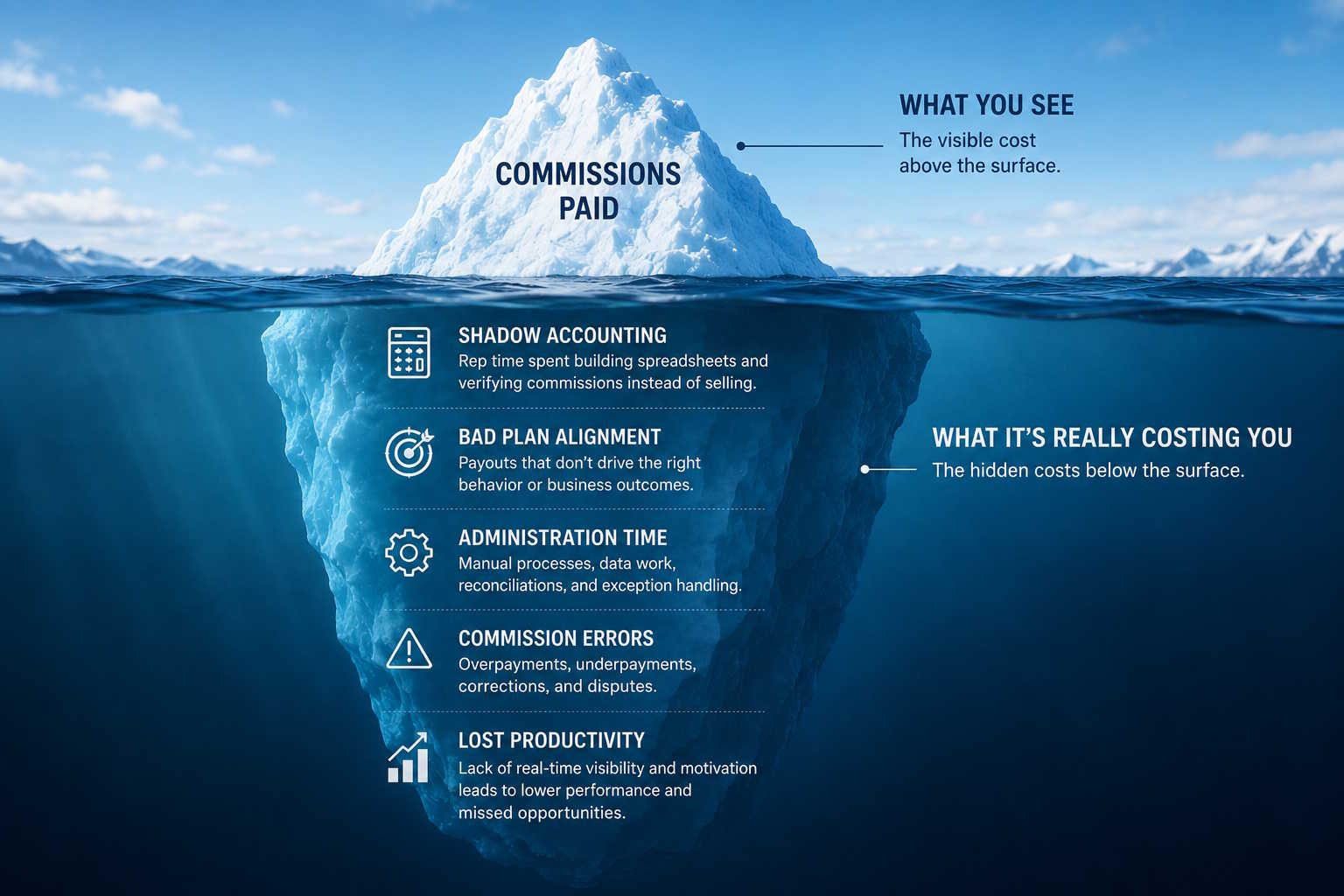
When companies think about the cost of sales compensation, they usually think about one number:
How much are we paying in commissions?
But that is only the most visible part of the cost.
Behind every commission payment is an operational process. Someone has to collect the data, calculate payouts, validate results, handle exceptions, answer questions, investigate disputes, make corrections, and explain how each number was calculated.
Sales reps often spend time doing their own calculations as well, especially when they do not completely trust or understand the numbers they see.
And there is an even bigger potential cost: a compensation plan that rewards behavior that no longer matches the company’s business strategy.
That is why evaluating the ROI of sales compensation software requires looking beyond software licensing costs.
The better question is:
What does our current sales compensation process actually cost us?
We built the EasyComp Sales Compensation ROI Calculator to help Finance and Revenue Operations teams answer that question using their own numbers.
Try the EasyComp Sales Compensation ROI Calculator
Start With the Economics of Your Sales Organization
Every company is different, so a useful ROI model should start with a few basic inputs about the organization.
1. How many employees earn commissions?
The number of commissionable employees is one of the biggest drivers of complexity.
Managing commissions for 15 sellers is very different from managing commissions for 150 or 1,500.
As the sales organization grows, so does the volume of:
- Transactions that need to be credited
- Quotas and plans that need to be maintained
- Promotions and territory changes
- New hires and departures
- Splits and exceptions
- Rep questions
- Adjustments
- Approvals
- Payment records
The workload does not always scale perfectly with headcount, but headcount provides a useful starting point for understanding the size of the compensation operation.
2. How often do you calculate commissions?
Payment frequency matters.
A company calculating commissions once per quarter goes through its compensation cycle four times per year.
A company calculating monthly goes through that process twelve times.
Every cycle can involve importing data, reconciling records, running calculations, validating payouts, answering questions, making corrections, and sending the final numbers to payroll.
The more frequently the process runs, the more valuable automation becomes.
This is why simply asking, “How long does commission processing take?” can be misleading.
The better question is:
How much time does the organization spend on commissions over an entire year?
3. What is the economic value of rep time?
The next useful inputs are the average on-target earnings (OTE) of a salesperson and the percentage of OTE represented by variable compensation.
Why do these numbers matter?
Because commission administration does not consume only Finance or RevOps time.
It consumes seller time too.
When reps cannot easily understand how a commission was calculated, they often recreate the calculation themselves.
They download CRM reports.
They maintain personal spreadsheets.
They compare closed deals with commission statements.
They send questions to their manager.
Their manager sends questions to RevOps.
RevOps investigates the transaction.
Finance may eventually become involved.
One commission question can create work across several departments.
A few minutes here and there may not seem significant. Multiply that across dozens or hundreds of sellers and across every commission cycle, however, and it becomes meaningful.
And seller time has an opportunity cost.
A salesperson investigating a commission calculation is not prospecting, working opportunities, or talking to customers.
4. What does compensation administration actually cost?
Another important input is the fully loaded annual cost of a compensation operations employee.
That means looking beyond salary.
The economic cost of an employee includes benefits, taxes, equipment, management overhead, office costs, and other expenses associated with employing that person.
Then consider how much of that person’s time is spent on activities such as:
- Preparing commission calculations
- Cleaning and reconciling data
- Maintaining spreadsheets
- Managing plan changes
- Processing exceptions
- Reviewing adjustments
- Answering rep questions
- Investigating disputes
- Preparing commission reports
- Supporting audits
- Correcting payment errors
These tasks are necessary.
But many of them are operational rather than strategic.
Automating them does not necessarily mean eliminating a position. In many organizations, the bigger benefit is freeing compensation analysts, Finance teams, and RevOps leaders to work on higher-value questions.
For example:
- Are our accelerators driving the right behavior?
- Are quotas producing the expected distribution of attainment?
- Are certain plan components paying commissions without generating incremental value?
- Are we spending our incentive budget where it has the greatest impact?
That is a very different use of compensation talent than spending days reconciling spreadsheets.
The Hard Savings Side of Sales Compensation ROI
When building an ROI case, we believe it is useful to separate relatively measurable savings from more speculative benefits.
Some of the most defensible savings generally come from three areas.
Administrative efficiency
How much time does Finance or Revenue Operations currently spend administering commissions?
If automation reduces the time spent assembling, calculating, reconciling, explaining, and correcting commissions, that time has measurable economic value.
Sales productivity
How much time do sellers and managers spend checking calculations, maintaining shadow spreadsheets, or asking compensation questions?
Giving sellers clear visibility into how commissions were calculated can return some of that time to selling.
Commission errors and overpayments
Errors can work in both directions.
Underpayments create rep frustration and require corrections.
Overpayments create direct financial leakage and can be particularly difficult to recover after money has already been paid.
A reliable compensation process should reduce both the operational cost of correcting errors and the financial impact of inaccurate payouts.
These are the types of savings that can form the foundation of a conservative business case.
Then There Is the Bigger Question: Are Your Incentives Driving the Right Behavior?
There is another category that can dwarf administrative savings, but it should be treated differently:
The cost of misaligned incentives.
This is why the ROI calculator also allows companies to enter average annual revenue per rep.
Consider what happens when a compensation plan unintentionally rewards the wrong behavior.
A plan might:
- Encourage excessive discounting
- Reward low-quality pipeline
- Overpay for renewals that required little selling effort
- Encourage reps to prioritize one product while the company is trying to grow another
- Reward bookings when the business increasingly cares about margin
- Continue paying heavily for a behavior that was strategically important two years ago but no longer is
The commission calculation can be 100% accurate while the incentive itself is economically wrong.
That is an important distinction.
Commission accuracy tells you whether you paid according to the plan. Incentive effectiveness tells you whether the plan was worth paying for in the first place.
Even a small improvement in seller behavior can potentially have a significant revenue impact across a large sales team.
But because that impact is harder to prove than administrative savings, it should not simply be mixed into the same ROI number.
That is why our calculator separates hard savings from potential revenue upside.
Build an ROI Case You Can Actually Defend
One of the biggest mistakes in software ROI models is starting with the answer you want and working backward.
Assume huge productivity gains.
Assume every error disappears.
Assign an aggressive value to every hour saved.
Assume revenue immediately increases.
You can make almost any software purchase look attractive that way.
A more useful model is deliberately conservative.
Start with numbers you know.
Use realistic assumptions.
If you do not believe a particular source of value applies to your company, exclude it.
If you believe an assumption is too aggressive, reduce it.
The objective should not be to produce the biggest ROI number.
It should be to produce a number that your CFO, CRO, or RevOps leader would be comfortable defending.
Calculate the Cost of Your Current Commission Process
The real cost of sales compensation is not simply what appears on the commission expense line.
It includes the people administering the process.
It includes sellers checking their payouts.
It includes disputes and corrections.
It includes overpayments and errors.
And potentially most importantly, it includes the economic consequences of incentives that encourage the wrong behavior.
Understanding those costs gives Finance and Revenue Operations teams a much better framework for deciding how much improving their sales compensation process is actually worth.
Instead of guessing, you can run the numbers yourself.
Try the EasyComp Sales Compensation ROI Calculator and build an estimate based on your own sales organization, compensation structure, and operating costs.