As you approach the end of the fiscal year (or even mid-year), it’s the perfect time to step back and assess one of the most powerful, and most expensive, levers in your GTM strategy: your compensation plan.
At its core, every comp plan is designed to do one thing:
Motivate your sales force at the right cost.
The best plans motivate top performers to stay and deliver their best work, while also making it very clear when someone isn’t succeeding in the role.
A comp plan is effective if it:
Drives the right behaviors
Pays people fairly and predictably
Achieves target business outcomes
Is financially sustainable
Is simple enough to understand and administer
But evaluating comp effectiveness isn’t something you should do only at the end of the year. It requires planning ahead and collecting the right data continuously (or using tools like EasyComp, which captures most of this by default).
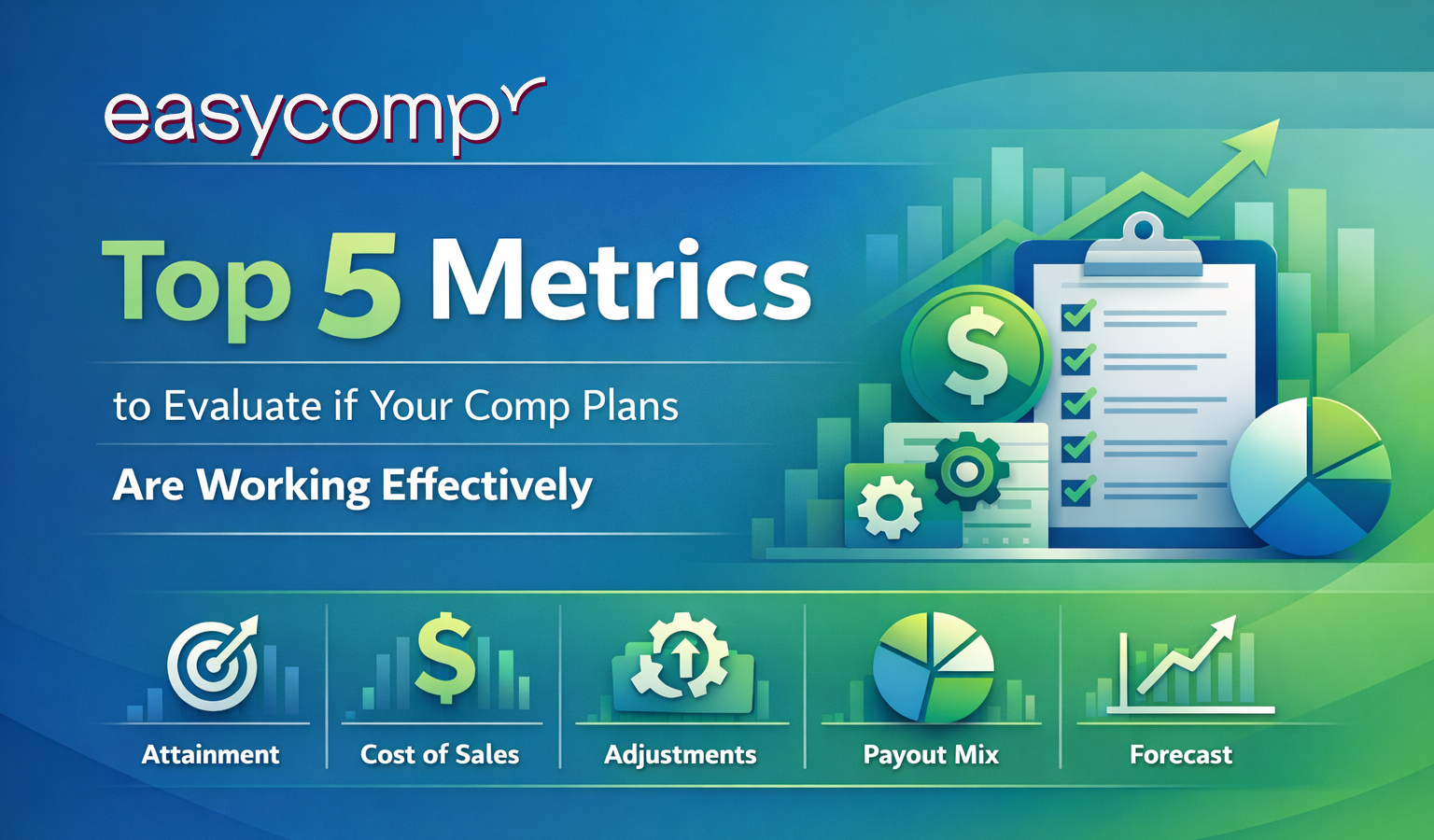
Here are five metrics worth tracking to understand whether your comp plans are actually working.
1) Attainment distribution
This is your histogram of sellers by quota attainment.
In an “ideal” world, you would see:
Mean attainment around 100 to 110%
A relatively tight standard deviation (0.2 to 0.3)
Around 65 to 75% of sellers at or above quota
Total payouts around 105 to 115% of your OTE pool
Why it matters: If attainment is too low, quotas might be unrealistic or the plan is not motivating the right behavior. If attainment is too high, especially paired with high payout, you may have under-set targets or accelerators that are too expensive.
A key red flag is a wide distribution (for example, a standard deviation around 0.6). That often results in fewer reps above quota and a higher total payout spend due to accelerators and budget volatility.
2) Cost of sales (variable comp as a percent of revenue, ARR, or ACV)
This is your top-level sustainability metric.
Most companies anchor comp cost against a key output like:
ARR or ACV booked
Revenue
Gross profit (for margin-sensitive businesses)
You want to track variable comp paid relative to the output it was designed to generate, and how that relationship changes over time.
Also keep in mind that costs often increase late in the fiscal year due to accelerators. Your forecast should anticipate that upward pressure.
3) Adjustment rate (adjustments as a percent of total payouts)
If your comp plan requires frequent exceptions to “make things right,” it is a sign of operational friction.
Examples include:
deal splits
double bubbles
manual corrections
special bounties
discretionary exceptions
These are sometimes unavoidable, but if they become a pattern they create risk. They are harder to audit, increase admin time, and can reduce rep trust.
A good benchmark is to keep adjustment payouts below 4% of total commissions paid.
4) Payout mix (commission dollars by plan component)
Many comp plans include payout components beyond the core quota, and often beyond OTE. Examples include:
multi-year deal incentives
services or implementation bonuses
expansion vs new logo multipliers
product-based incentives
SPIFs
These components can represent a meaningful portion of payout dollars, so you want to know what you are actually paying for.
It is not uncommon to find situations where 40 to 50% of payouts are driven by SPIFs or non-core components. In those cases, the company might hit its payout budget while missing its core ARR goal.
If that happens, it may be time to recalibrate the plan, because you may be incentivizing outcomes that are not aligned with what the business needs.
5) Payout predictability (variance vs forecast)
One of the most underappreciated metrics is how predictable your comp spend is month to month.
Even if your plan drives the right behavior, payout surprises create finance frustration, payroll stress, and changes in comp policy midstream. That can quickly erode rep trust.
Tracking forecasted vs actual payouts is a powerful way to measure whether your plan is stable and manageable.
Final thought
Comp plans should not be evaluated only once a year. They should be monitored continuously so there are no surprises at the end of the fiscal year.
The right dashboards and systems make this easier, but even a lightweight review cadence can prevent expensive misalignment.
By Jose Fernandez
About the Author
Jose Fernandez is part of the team behind EasyComp.ai, building infrastructure that helps companies run sales compensation without spreadsheets, confusion, or delays. He believes incentive systems should be easy to operate—and crystal clear to the people who earn them.