Revenue Operations • Sales Compensation
What Revenue Operations Teams Need Most in Sales Compensation Management (and How EasyComp Delivers)
Learn what matters most to Revenue Operations teams in sales compensation management: fast implementation, CRO-ready flexibility, payout clarity, CFO-grade metrics, seamless integrations, and low operational overhead—and how EasyComp delivers.
By EasyComp Editorial Team •
Why Sales Compensation Is a RevOps Priority
Sales compensation is no longer a back-office calculation. For modern Revenue Operations (RevOps) teams, compensation is revenue infrastructure that shapes sales behavior, improves forecast confidence, and strengthens trust between Sales and Finance.
When compensation operations are slow, unclear, or manual, the entire revenue engine slows down: reps lose confidence, disputes rise, commission expense becomes harder to control, and leadership cannot iterate quickly on go-to-market strategy.
Core Challenges RevOps Teams Face
As revenue organizations grow, RevOps teams often see the same issues emerge in commission workflows:
- Manual commission calculations spread across spreadsheets
- Disputes caused by unclear payout logic and inconsistent adjustments
- Slow plan changes when CRO priorities shift mid-quarter or mid-year
- Limited visibility into commission expense, exposure, and accruals
- Disconnected data between CRM, finance, payroll, and reporting layers
- High operational burden every pay cycle
The result is predictable: lower rep motivation, higher admin overhead, reduced leadership confidence, and slower revenue execution.
What Matters Most to Revenue Operations Teams in Compensation Management
1) Speed of Implementation and Execution
RevOps teams rarely have quarters to deploy new tooling. Compensation systems must go live quickly and show value fast, without heavy consulting or endless back-and-forth on requirements.
2) Flexibility to Match the CRO Agenda
CRO priorities evolve: new GTM motions, territory changes, emerging product lines, or incentive experiments. RevOps needs compensation that can change safely and quickly without rebuilding the system every time leadership updates strategy.
3) Clarity of Payouts That Builds Rep Trust
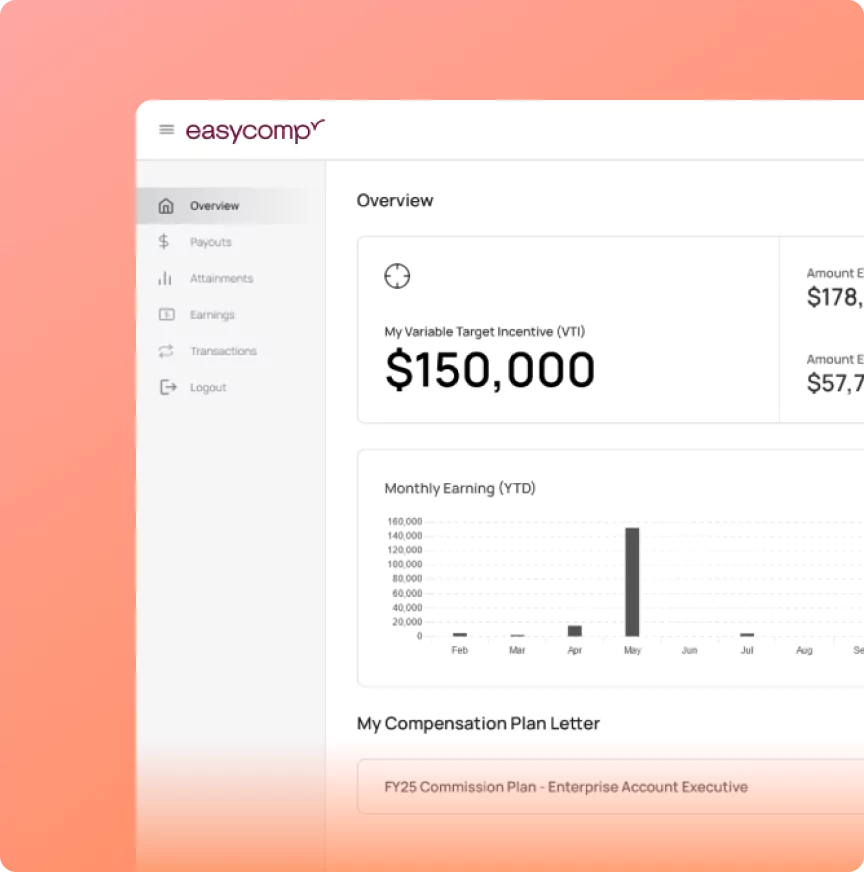
Reps need to answer “How am I getting paid?” with confidence. Clear payout breakdowns reduce disputes, increase trust, and keep sales teams focused on closing revenue instead of chasing explanations.
4) Transparency That Improves Sales Productivity
Real-time visibility into earnings, accelerators, and milestones motivates reps and supports better coaching. It also reduces the friction that comes from delayed or confusing payout reporting.
5) Metrics That Matter to CFOs and CROs
Compensation is one of the largest variable expenses. Leadership needs CFO-grade reporting: commission expense visibility, exposure and accruals, payout timing, margin impact, and plan effectiveness.
6) Integration Into the Revenue Tech Stack
Compensation must integrate into the systems RevOps already manages: CRM, finance, payroll, and reporting. Without strong integrations, RevOps teams end up building manual pipelines and reconciliation layers.
7) Ease of Management at Scale
RevOps does not want another tool that requires full-time administration. The best systems reduce ongoing workload through automation, clear workflows, and maintainable plan management.
Why EasyComp Aligns With RevOps Priorities
Fast implementation, designed for RevOps velocity
EasyComp is built to go live quickly and deliver value early, without slowing down the broader RevOps roadmap.
Flexible plan management that follows CRO priorities
EasyComp makes it easier to evolve compensation as strategy changes—supporting plan updates, incentives, and new structures without heavy operational disruption.
Clear payout breakdowns that reduce disputes
EasyComp provides clear explanations of how payouts are calculated, helping reps understand earnings and minimizing time lost to commission questions.
Executive-ready reporting for CFOs and CROs
EasyComp highlights the metrics leadership cares about: commission expense visibility, plan effectiveness insights, and performance distribution across reps and teams.
Integration-first approach and low admin overhead
EasyComp is designed to fit into modern RevOps stacks and stay easy to manage—reducing reconciliation, streamlining workflows, and keeping operations lightweight over time.
Bottom line: EasyComp is built around the needs of Revenue Operations—speed, clarity, flexibility, and leadership-grade visibility.
Final Thoughts: Compensation Is Revenue Infrastructure
In 2026, sales compensation management is a strategic requirement for RevOps teams. It determines how quickly leadership can execute strategy, how confident reps feel in payouts, and how clearly finance can forecast commission expense.
Modern RevOps organizations treat compensation as infrastructure—not an afterthought. EasyComp is built to power that infrastructure with speed, clarity, and executive-ready reporting.
FAQ
Why is sales compensation management important for Revenue Operations?
It affects sales behavior, rep trust, forecasting accuracy, commission expense control, and the speed at which the CRO can execute go-to-market strategy.
What should RevOps teams look for in sales compensation management software?
Prioritize fast implementation, flexibility for plan changes, clear rep-facing payout breakdowns, CFO-ready metrics, strong integrations, and low ongoing operational overhead.
How does payout clarity improve sales productivity?
Clear payouts reduce disputes and distractions, increase trust, and keep reps focused on selling with real-time visibility into earnings and incentives.
What metrics matter most to CFOs and CROs for sales compensation?
Commission expense visibility, exposure and accruals, payout timing, margin impact, plan effectiveness, and performance distribution across reps and teams.
How does EasyComp support Revenue Operations teams?
EasyComp supports RevOps with fast implementation, flexible plan changes aligned to CRO priorities, clear payout explanations, executive-ready reporting, strong integrations, and low admin overhead.